Halley first appeared as a tiny dot on photographic plates taken with a telescope by German astronomer Max Wolf on the night of September 11–12, 1909, during its passage in the early 20th century. This was confirmed by naked-eye observation with the Yerkes Observatory’s 40-inch telescope on September 15, and then things got a little confusing. In January 1910, while everyone was sitting—it’s a proven fact—waiting for Halley’s Comet, a much brighter celestial object visible even in sunlight was observed. This unexpected visitor attracted considerable attention, so much so that the actual Halley Comet’s passage in mid-April drew relatively less interest. News appeared in newspapers of the time that scientists, using spectrometer scans, had detected cyanogen gas (CN₂)—a toxic gas related to cyanide—in the comet’s tail, and that the Earth would pass through the tail. People bought gas masks, and an enterprising Haitian medicine man began selling anti-comet pills made from herbs. There was so much demand that he couldn’t keep up with the orders.
National tribune (Washington, D.C.), June 2, 1910
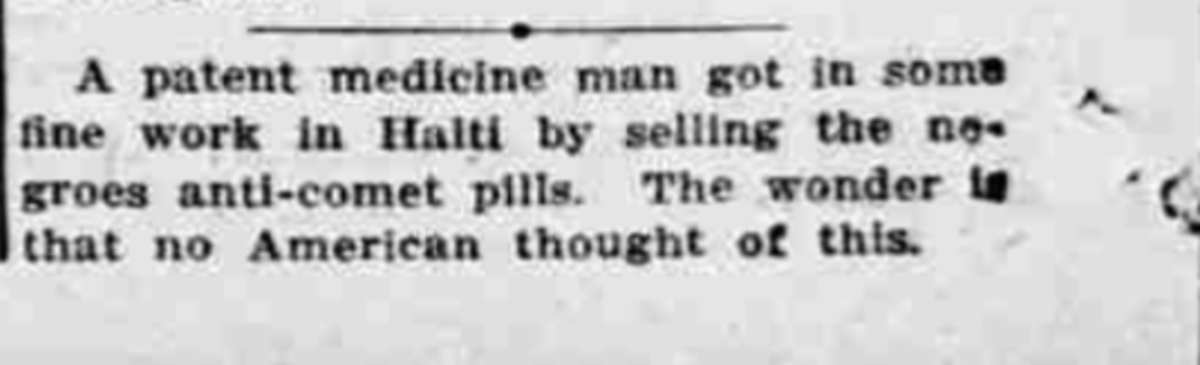
Comet Pills: The National tribune (Washington, D.C.), June 2, 1910